
FAIR² Drones: An AI-Ready Standard for Cross-Domain Wildlife Drone Dataset
Jenna Kline · From Mobilizing Data to AI-Ready Knowledge: Infrastructure for Multimodal Biodiversity Data
The short versionA shared dataset card that captures ecological, robotic and computer vision metadata makes costly drone datasets reusable across disciplines.
What this was about
Jenna Kline presented FAIR² Drones, a proposed metadata standard for wildlife drone datasets used by ecologists, roboticists and computer vision researchers. It grew out of the 2025 Wild Drone Hackathon in Kenya, where participants found that having files was not the same as being able to reuse them across disciplines, because each field needs different context. FAIR² Drones is an integration layer, not a replacement standard. It builds on FAIR and AI-ready principles and Darwin Core with the Humboldt Extension, and encodes platform, mission, sensor, annotation and provenance metadata in a machine-readable dataset card with nine components. She showed the KABR worked example on Hugging Face, a quick-start guide, five more case studies, and an extension to multi-sensor deployments used for the SmartWilds dataset.
Why it matters. Drone fieldwork is expensive and collaborative. Documenting it for all communities maximises return on investment and enables coordinated, adaptive multi-sensor monitoring.
In the room
- Ecological data are increasingly multimodal and multiscale; the framing should extend from AI + ecology to robotics and computer systems.
- Different disciplines need different reuse metadata: ecology (what, where, when, protocol), robotics (platform, trajectory, control mode, sensor configuration), computer vision (labels and how produced).
- FAIR² Drones is an integration layer over FAIR, AI-ready principles, Darwin Core and the Humboldt Extension, not a new competing standard.
- The dataset card encodes platform, mission, sensor, annotation and provenance metadata; events capture mission details and occurrences capture frame-level telemetry.
- Nine schema components act as a checklist, e.g. prompting ecologists to record calibration and roboticists to record class balance.
- Worked example: KABR (Kenyan Animal Behavior Recognition) on Hugging Face, plus a quick-start guide from minimal viable to detailed metadata.
- Five additional case studies (multi-view drone swarms, 3D reconstruction, lion behaviour, humpback whale RGB+thermal tracks) were used to stress-test the standard.
Notable moments
Transcript
Automatically generated captions can contain mistakes, especially in names and technical terms. Times are relative to the room recording.
Read the transcript ↓
Related talks.
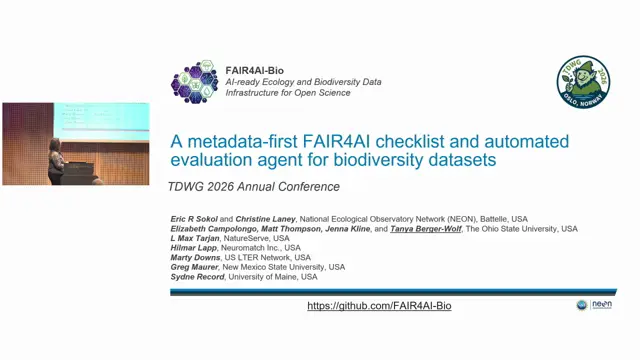
A metadata-first FAIR4AI checklist and automated evaluation agent for biodiversity datasets
FAIR4AI is mainly a metadata gap, and a community checklist plus an automated agent can measure and help close it while tracking provenance and governance back to data sources.
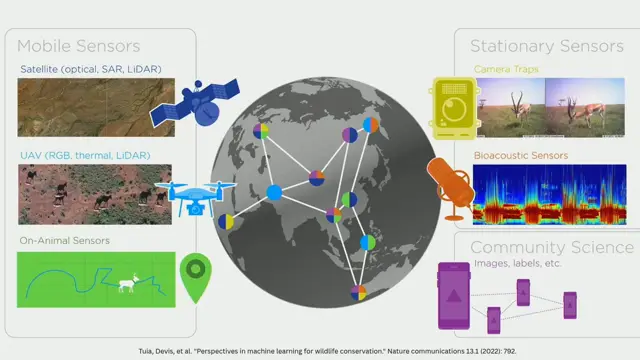
Cross-Modal Coordination for Biodiversity Monitoring at Scale: Lessons from SmartWilds
Coordinating multiple sensor modalities with AI at the far edge, informed by synchronised multimodal datasets like SmartWilds, can scale and adapt biodiversity monitoring.
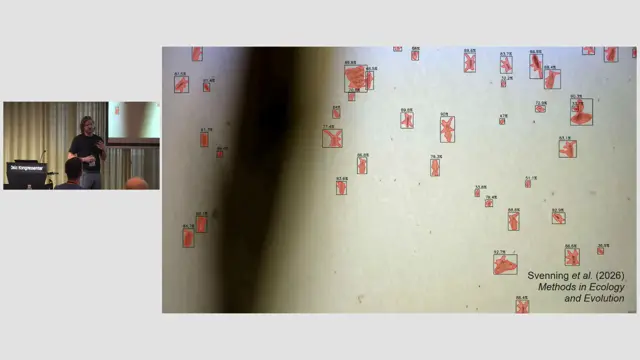
Standardizing Multimodal Insect Monitoring Data for AI-Ready Pipelines: Lessons from an InsectAI Community Datathon
Camtrap DP can largely accommodate automated insect monitoring data today, but the community needs agreed guidance and a few targeted extensions (track IDs, parent media and crop offsets, target taxonomic scope, identification provenance) to handle insect-specific challenges.