
Adopting Environmental Sustainability as a Strategy to Build Resilient Data Infrastructures in Biodiversity Science
Giuditta Parolini · Building resilient data infrastructures for biodiversity science
The short versionBuilding frugal, environmentally sustainable data infrastructures is a practical risk-management strategy for resilience.
What this was about
Giuditta Parolini argues that environmental sustainability, rarely discussed in research data management, should be treated as a risk-management strategy rather than a nice-to-have. Drawing on the International Energy Agency (growing demand, geopolitical fragmentation, grid limits strained by AI data centres, pressure on critical materials such as rare earths and lithium, slow climate mitigation) and a 2023 ESFRI report on energy and supply challenges, she defines resilience as continued availability of core services under political, legal, financial and technological change. Frugal infrastructures that need fewer resources are better placed to face rising hardware and energy costs and growing EU environmental reporting duties, and biodiversity data are especially at risk because they are politically contentious.
Why it matters. It reframes green IT from a values question into a resilience argument that infrastructure managers and funders can act on as energy, hardware and compliance risks grow.
In the room
- Sustainability in RDM is usually discussed in financial or social terms, rarely environmental, even though IT infrastructure use of electricity, hardware and e-waste keeps growing.
- The IEA identifies growing energy demand against geopolitical fragmentation and grids not keeping pace, partly due to generative-AI data centres.
- Supply chains for critical materials are under pressure (e.g. the 2025 Chinese export restrictions on rare earths; lithium provisioning).
- Resilience = continued availability of core services under political, legal, financial and technological change; build it by defining core services, identifying risks and adopting a risk-management strategy.
- ESFRI (2023, after COVID and the Ukraine invasion) recommended greening operations, including materials, reuse and recycling, as risk management.
- Biodiversity data are politically contentious and face energy/hardware cost risks plus EU environmental regulation and reporting duties.
Notable moments
Transcript
Automatically generated captions can contain mistakes, especially in names and technical terms. Times are relative to the room recording.
Read the transcript ↓
Related talks.
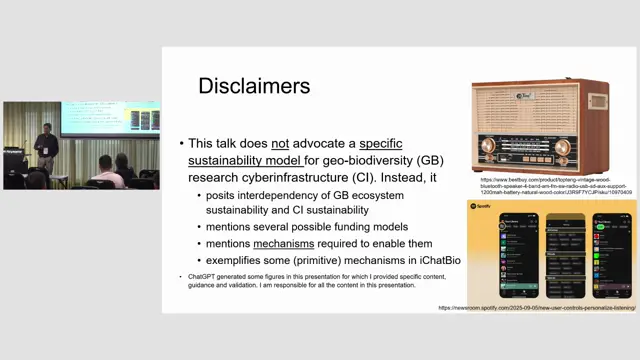
Requirements of Sustainability Models for Geo-Biodiversity Data Cyberinfrastructure
Cyberinfrastructure sustainability and ecosystem sustainability go hand in hand, so infrastructure must be designed from the start to track use and support economic orchestration.

SYM18 discussion: who sustains biodiversity data infrastructures?
Volunteer and single-developer infrastructures deliver proven value, but the community lacks mechanisms and funding to protect them.

Sustainability and collaboration in a time of uncertainty
Sustaining biodiversity data infrastructure requires treating technology, people and a diversified funding portfolio as one interconnected system.