
Drawers in the dark harboring data that could spark - finding the sweet spot in collection digitization and mobilizing metadata from museum's collections
Nora Lentge-Maaß · From Cabinets to Clouds - Bridging the gap between collection- and database management
The short versionPlan digitisation for the easy 95%, capture a minimal dataset, and decide when good enough beats perfection.
What this was about
Nora Lentge-Maaß described MfN's state-funded plan to digitise about 30 million objects holistically: condition assessment, conservation, inventory, digitisation and preparation for the move to a new building. Four digitisation managers and five scan operators were hired. Her showcase was DORA, a malacology digitisation station built with Fraunhofer IAO. It has four cameras with focus stacking, reads QR codes and outputs JSON metadata, and has processed about 170,000 of 260,000 lots (about 85% disclosed). A 2023 cyber attack took systems offline until July 2024 and forced reorganisation into a digitisation-on-demand office, the DCI team and an innovation lab. The lab's new Fides station images insects from several angles. Her take-home: plan for the easy 95%.
Why it matters. It gives practical lessons from one of the largest museum digitisation programmes, including recovery from a cyber attack, with transferable guidance on minimal datasets and workflow design.
In the room
- MfN's holistic approach combined condition assessment, conservation, inventory, digitisation, QA and new storage, driven by user demand.
- Holdings were split into four categories with dedicated digitisation managers; 80% of objects were in historical cabinets.
- DORA station: four built-in cameras, focus-stacked tray images with colour chart and scale, label capture, QR-code file naming, and JSON metadata output.
- About 170,000 of about 260,000 malacology lots (about 7 million objects) processed; about 85% of the collection disclosed by 19 September.
- A 2023 cyber attack destroyed back-end systems; MfN was offline from October 2023 to July 2024.
- New structure: coordination office for digitisation on demand (with a request form), the digital catalogue infrastructure (Specify, media repository, data portal) and an innovation lab (ELIO).
- The Fides station (with a small company) uses consumer cameras and multi-angle imaging for entomology, but captures media only; AI label transcription runs separately.
Notable moments
Transcript
Automatically generated captions can contain mistakes, especially in names and technical terms. Times are relative to the room recording.
Read the transcript ↓
Related talks.
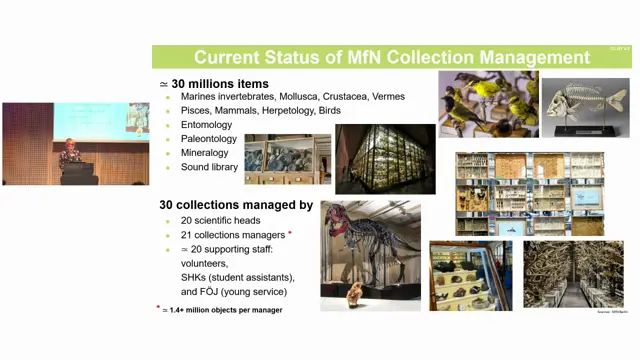
The Good, the Bad, and the Standardised: A Specify Journey Through 200 Years of the MfN Berlin's Biological Collections
Specify's flexibility lets MfN consolidate 30 historically complex collections into one database while starting to reconstruct colonial and wartime history, but geography and historical events remain unsolved.
Digitising Plant and Fungal Collections at Royal Botanic Gardens, Kew: Applying International Standards to Support Data Sharing and Geospatial Analysis
WGSRPD enables cross-collection geospatial analysis at Kew, but historical, heterogeneous data leave half of records without fine-level assignment.
From Images to Structured Data: A Scalable AI Workflow for Natural History Museums
A simple 'just do it' AI transcription pipeline with schema prompts, an intent step and full provenance can make label digitisation scale.